
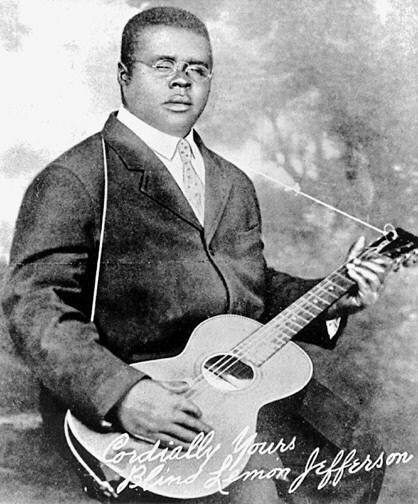
A blind man and a boy walked into every bar on Elm Street. One of them would grow up to invent electric blues guitar.
If you stood at the corner of Elm Street and Central Avenue in Dallas in the early 1920s, you were standing at the center of the world as far as Black Texas music was concerned. The railroads had drawn commerce and people to this stretch of east Dallas for decades — the Texas and Pacific crossed the Houston and Texas Central right here, and the neighborhood that grew up around those tracks was called Deep Ellum. What it lacked in polish it made up for in electricity. On any given evening, the sidewalks carried the sound of a dozen guitars.
Lead Belly was here. Lightnin’ Hopkins passed through. Bessie Smith played the Ella B. Moore Theater on Central Avenue. And holding court on his preferred corner, tin cup in hand and guitar across his lap, was a stout, sightless man from Freestone County named Lemon Jefferson.
The Father of Texas Blues
Lemon Henry Jefferson was born in 1893 in Coutchman, a small farming community in Freestone County east of Waco, the youngest of seven children in a sharecropper family. He had been blind from birth, or nearly so. He learned to play guitar as a child and began performing at picnics and dances around East Texas — a young man with an extraordinary voice and a guitar style unlike anything his neighbors had heard before: intricate, conversational, the bass line and melody intertwining in ways that seemed to require more than two hands.
By the late 1910s, Jefferson had found his way to Dallas. The city’s African American community was concentrated in a corridor southeast of downtown, and Deep Ellum was its entertainment heart. Jefferson was restricted from most of white Dallas. But Deep Ellum was his. He worked the corner of Elm and Central Tracks, playing for tips, his massive voice carrying over the street noise and the passing trains. People stopped walking when he played.
Paramount Records came calling in the early 1920s. Jefferson traveled to Chicago to record, and the results electrified the country. He cut more than eighty sides for Paramount — “Matchbox Blues,” “See That My Grave Is Kept Clean,” “Black Snake Moan” — and became one of the best-selling blues artists of the decade. He had admirers across the South and in Chicago and New York. They called him the Father of Texas Blues, and the title fit.
A Family Friend
Around this time, a boy named Aaron Thibeaux Walker was growing up in Dallas, the son of a musically gifted family. His parents were both musicians. His stepfather, Marco Washington, played with the Dallas String Band and taught Aaron guitar, ukulele, banjo, violin, mandolin, and piano. Music wasn’t something the family did on weekends — it was the atmosphere of the household.
Blind Lemon Jefferson was a family friend. He came over for dinner. He knew Aaron’s people, felt comfortable with them, and the boy grew up in proximity to one of the greatest blues musicians alive. When Jefferson needed someone to guide him through the bars and dance halls of Deep Ellum — to put an arm out before a step down, to navigate a crowded room, to count the money in the cup — Aaron Walker was the one who went along.
The Transaction

The arrangement was simple: Aaron led, Jefferson played. The boy guided him from bar to bar along Elm Street as the older man worked the room for tips, his guitar propped on his knee, his voice rolling out over the noise. Jefferson taught the boy the basics of blues guitar in return — not as a formal lesson, but the way music passes between people who are always around it. The student absorbed what he could.
It wasn’t an unusual arrangement. Blind Lemon had other guide-boys in other cities. Huddie Ledbetter — Lead Belly — had known Jefferson in the same Deep Ellum streets. Down in Houston, a young Sam Hopkins was doing the same job, leading Jefferson from venue to venue in exchange for music lessons; Hopkins would become Lightnin’ Hopkins, one of the defining Texas blues voices of the mid-twentieth century. In Atlanta, Josh White served the same role. Jefferson scattered guitar knowledge behind him the way he scattered tips coins — without ceremony, as the price of navigation.
What the Student Learned
Aaron Walker left school at ten and was a professional performer by fifteen, working carnivals and medicine shows and dance halls around Texas. He made his first recording in 1929 for Columbia Records, billed as “Oak Cliff T-Bone” — Oak Cliff being his Dallas neighborhood, T-Bone a corruption of his middle name Thibeaux. The single, “Wichita Falls Blues” backed with “Trinity River Blues,” hinted at what was coming without fully revealing it.
What came, around 1940, was a revolution. T-Bone Walker plugged in. He amplified the electric guitar and moved it from rhythm to lead, playing single-string lines that bent and cried and talked back to the vocals the way Jefferson’s acoustic lines had once done on Elm Street. He held the guitar behind his head, did full splits on stage, grinned through his solos. He was dazzling. His 1947 recording “Call It Stormy Monday (But Tuesday Is Just as Bad)” became the defining statement of the West Coast blues — a song so perfectly constructed and performed that it seemed inevitable, as if it had always existed and he had simply found it.
The musicians who heard Walker and couldn’t forget him include nearly everyone who mattered in the second half of the twentieth century: B.B. King, who said that when he first heard T-Bone he thought “Jesus himself had returned to earth playing electric guitar.” Eric Clapton. Jimi Hendrix. Stevie Ray Vaughan. Otis Rush. Albert King. Chuck Berry. The DNA of rock and roll runs, in large part, through a boy who once guided a blind man down Elm Street in Deep Ellum, learning guitar as he went.
A Death in the Snow
Blind Lemon Jefferson died in Chicago on December 19, 1929. He was thirty-six years old. The exact circumstances have never been established. His death certificate, filed under an incorrect first name and not discovered until 2010, listed the probable cause as acute myocarditis. Competing accounts have him dying in a snowstorm after a recording session, disoriented and alone; or poisoned by a jealous lover; or robbed of a large royalty payment on his way to the train station. The mystery suits him somehow — a man who moved through the world by sound and touch, who never needed to see where he was going because he always knew.
He was buried back in Texas, at Wortham Negro Cemetery in Freestone County, not far from where he was born. The grave went unmarked for years. In 1967, a Texas State Historical Marker was placed there. In 1997, a new granite headstone was installed, paid for by Paramount Records and admirers who hadn’t forgotten. Deep Ellum hadn’t forgotten either.
Deep Ellum Today
Deep Ellum nearly disappeared in the 1950s when Central Expressway was bulldozed through the neighborhood, severing the Central Tracks corridor that had given the district its identity. It revived in the 1980s as a music and arts scene, declined again, and revived once more. Today it is one of Dallas’s most active entertainment districts, with music venues, murals, and restaurants along Elm and Main streets.
A mural of Blind Lemon Jefferson watches over the neighborhood he made famous. T-Bone Walker has a historical marker in Oak Cliff, the Dallas community where he grew up. The corner where the boy once guided the blind man from bar to bar doesn’t look much like it did in 1922. But the music that passed between them that night — and every night they walked Elm Street together — is still echoing.