
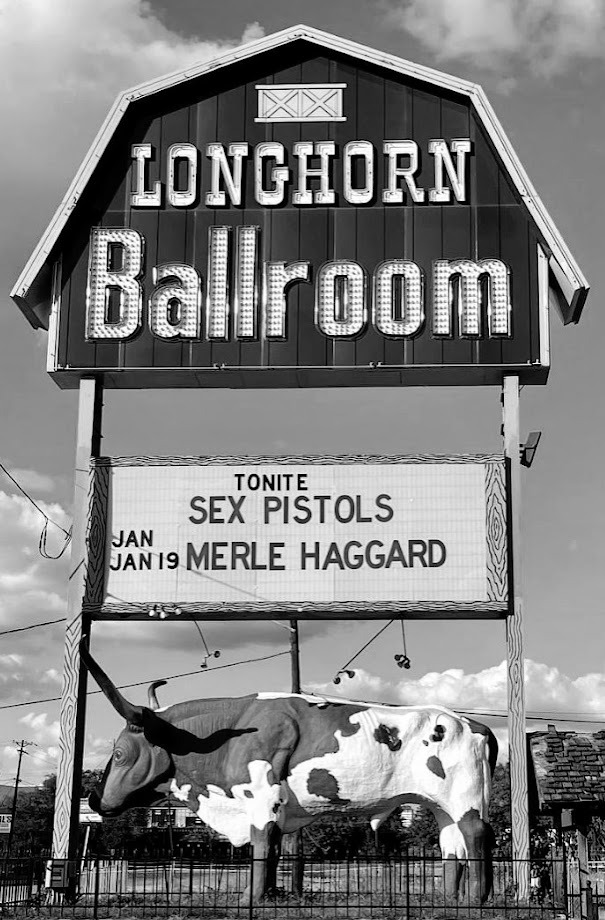
The marquee said it all: TONITE SEX PISTOLS
In 1950, an eccentric Dallas millionaire named O.L. Nelms decided to build his close friend Bob Wills the greatest dance hall in Texas. Nelms — born Ocie Lee Nelms in Waxahachie, dropped out in the third grade, made his first money peddling tobacco, then built a fortune in real estate. He had a taste for grand gestures. The venue that rose at 216 Corinth Street in south Dallas was certainly that.
Bob Wills’ Ranch House opened on Nov. 15, 1950, with a parade down Corinth Street and a two-hour broadcast on WFAA television. The dance floor could hold 2,000 people. Wills played with the Texas Playboys on a regular basis, the bandleader in his white hat, sawing his fiddle over the stomp and swing of the music that had made him a legend across the Southwest.
But, it didn’t last. Despite the grand opening, despite the TV cameras and the famous name on the marquee, the Ranch House couldn’t sustain itself financially. Wills closed it in January 1952. He’d had the greatest dance hall in Texas for 14 months.
Jack Ruby Takes the Door
Into the vacancy stepped a Dallas nightclub operator named Jack Ruby. You may have heard the name. In 1952, Ruby and his business partner Hy Fader bought the Ranch House from O.L. Nelms. Ruby hired a young bandleader named Dewey Groom to run the door and lead the house band — Groom renamed the place the Longhorn Ranch after his own outfit, and the name stuck.
Ruby kept the country and western acts coming, but he also did something unusual for Dallas in 1952: he opened the Longhorn Ranch to Black audiences on Monday and Tuesday nights. These events featured some of the finest African American performers of the era — Count Basie, Ruth Brown, Nat King Cole. It was a quiet act of integration in a city that still practiced rigid segregation in its nightclubs and dance halls.
But like Bob Wills before him, Ruby couldn’t keep the place solvent. He closed the Longhorn Ranch at the end of 1953. By his own account, he suffered a mental breakdown afterward (oh, that explains a lot) and spent several months “hibernating” at the Cotton Bowl Hotel, a few miles north on Corinth Street. He eventually recovered, moved on to smaller clubs downtown, and by the early 1960s was operating the Carousel Club at 1312½ Commerce Street in the heart of Dallas.
On November 24, 1963, two days after President Kennedy was shot at Dealey Plaza, Jack Ruby walked into the basement of Dallas Police Headquarters and shot Lee Harvey Oswald in front of a live television audience. He died in jail in 1967, before his appeal could be heard. The rest is history — or debated history.
Dewey Groom and the Golden Age of Country

In 1967, O.L. Nelms sold the property to Dewey Groom, the bandleader who had run the door for Jack Ruby 15 years earlier. Groom renamed it the Longhorn Ballroom, added the barn-shaped facade and the painted longhorn bull sculpture out front in 1968, and turned the place into one of the premier country music joints in the South.
The names that came through the Longhorn during Groom’s tenure read like a country music hall of fame roll call: Patsy Cline, Merle Haggard, Johnny Cash, Willie Nelson, Tammy Wynette, George Jones, Ray Price, Conway Twitty, Loretta Lynn, Charley Pride, Hank Thompson. George Strait made an early career appearance here. The stage was big enough, the floor was wide enough, and Dallas was hungry enough that the Longhorn could carry legends for decades.
But Groom wasn’t precious about the booking. Over the years the Longhorn also hosted the Ramones, Motorhead, the Butthole Surfers, the Flaming Lips, and, in 1986, Nigerian afrobeat pioneer Fela Kuti for his final Dallas show. That ol’ barn-shaped sign had seen a few things.
They Killed Kennedy Here
The Sex Pistols arrived in Dallas on January 10, 1978 — two days after their notorious show at Randy’s Rodeo in San Antonio, and four days before the final concert of their existence at Winterland in San Francisco. Sid Vicious confessed his nerves to a journalist before the show. “They killed Kennedy here,” he said, “and everybody has warned us that the people are crazy.”
“They killed Kennedy here, and everybody has warned us that the people are crazy.” – Sid Vicious
Out front, the Longhorn Ballroom marquee read: TONITE SEX PISTOLS. Below that: JAN 19 MERLE HAGGARD. A photographer captured the sign against a cloudy Texas sky, with the painted longhorn bull grazing underneath both names. It became one of the most reproduced images from the entire tour — an accidental masterpiece of cultural collision. Tickets were $3.50.
The opening acts were local bands Ultra and the Nervebreakers. Then the Pistols took the stage, and the evening delivered its share of chaos. A woman grabbed Sid Vicious by the dog-collar necklace around his throat and punched him square in the nose. He bled. Bodyguards appeared from the wings carrying machetes(!), ready to intervene. Vicious waved them off. “No, no,” he said. “She’s alright.” Both Rotten and Vicious were reportedly punched in the face by women in the crowd over the course of the night, which said something about the audience’s mood, or perhaps their enthusiasm, or both.
The Dallas show was recorded and has circulated in various forms ever since. The setlist ran through “Anarchy in the U.K.,” “God Save the Queen,” “Pretty Vacant,” “Bodies,” “No Fun” — the whole compressed fury of Never Mind the Bollocks played in the house that Bob Wills built for Jack Ruby’s boss.
The Ballroom Today
The decades that followed were, call it, uneven. The Longhorn changed hands, struggled, and eventually slid into bankruptcy. By the 2010s it sat dark and deteriorating at 216 Corinth Street, the barn-shaped sign still standing but the dance floor quiet. Preservationists worried it was gone for good.
Funny thing, turns out it wasn’t. New owners purchased the Longhorn out of bankruptcy in 2022 and put it through a full renovation — new plumbing, insulation, sprinklers, air conditioning, and a steel beam to hold the old structure together. On March 30, 2023, the Longhorn Ballroom reopened with a show by Asleep at the Wheel, the Austin western swing band that had spent 50 years keeping Bob Wills’s music alive. On Feb. 1, 2024, the Longhorn Ballroom was listed on the National Register of Historic Places.
In 2022, British director Danny Boyle brought a film crew to the revived Longhorn to shoot scenes for Pistol, his fictionalized account of the Sex Pistols’ story, restaging the 1978 show in the same building where it happened. Bob Wills’ ranch house, Jack Ruby’s nightclub, Dewey Groom’s country hall — and the stage where Sid Vicious got punched in the nose and said the woman who did it was alright.