
Forty miles west of Lubbock on Highway 84, you pass through Littlefield, Texas — the town that made Waylon Jennings. Keep driving and you cross into New Mexico. That’s where Waylon’s son went in 2025 to make Charley Crockett’s most important record.
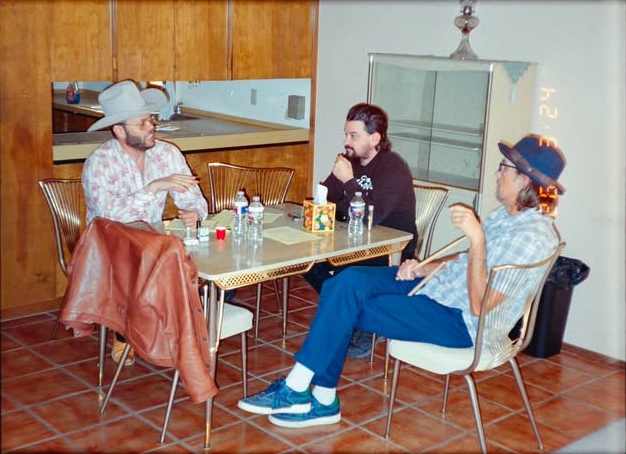
In July 2025, Charley Crockett arrived at Norman Petty’s studio in Clovis, New Mexico. And he came a long way — from his birthplace in San Benito, Texas, deep in the Rio Grande Valley. Producer Shooter Jennings came with him. The studio is where Buddy Holly changed American music — and both men knew it.
Norman Petty built his recording studio in Clovis in the early 1950s. He recorded Buddy Holly there — “That’ll Be the Day,” “Peggy Sue,” “Rave On.” He also recorded Roy Orbison and the Fireballs inside those same walls. Indeed, the federal government designated it a national landmark. Today, every room is period-correct for the 1950s and early 1960s. And photos of the young artists who recorded there line every wall. Even today, fans stop by throughout the week, hoping for a tour. But in July 2025, something new was happening in that room.
The Clovid Sessions
They booked the studio for four days. The plan: get some tracks down, then finish back in Los Angeles. But four days in, they had eight songs — and nobody wanted to leave. Also, half the crew had come down with Covid. They renamed the sickness “Clovid” and kept going. Crockett caught it on the second day of tracking. He worked through it anyway. In a July 11 Facebook post, Jennings described Crockett working through it “like a snowplow barrels through snow.” “A true ram,” Jennings wrote.
But tomorrow morning’s flights home to Los Angeles already had their names on them. Crockett’s wife Taylor Grace had planned a 42nd birthday surprise back in California. A wrecking ball to all plans. Still, Jennings made the case to stay two more days and finish the record. He called his wife Misty to apologize in advance. She responded by booking herself a long-overdue hair appointment — pink, finally. “She’s still mad,” Jennings noted. Crockett agreed. They stayed.
Last Night at the Alamo
One song had eluded them the entire stay. And “Last Night at the Alamo” mattered deeply to Crockett. He and Taylor had worked on it before arriving in Clovis. But the music wouldn’t fit the emotion in the lyrics. So the band sat at their stations inside the studio for six hours and waited. Then Jennings stepped outside and met Crockett in the parking lot. He held out his phone, playing “Early Morning Rain” by Bill Emerson and Cliff Waldron — old bluegrass, nothing like the song they’d been fighting all week. Something shifted.
Standing in the open air, as the sky turned deep blue over the desert, Crockett found the song. He played “Last Night at the Alamo” straight through, from start to finish, in one take. The Blue Drifters had waited six hours. Yet Crockett needed only one pass. “It was like magic,” Jennings wrote. “It was conjuration.” Then they all walked inside and put it on tape.
Clovis
They captured thirteen songs in six days. On Crockett’s 42nd birthday, he and Taylor and their dog Billie rode his tour bus back to California. So Jennings brought the record to his Snake Mountain studio in Los Angeles to finish it. But the more they added, the more they covered up what was already there. So they stopped adding. Clovis had already happened in that room.
“I ended up making one of the most important records in my life with Charley,” Jennings wrote. Then came the detail that seemed almost too perfect. That same morning they finished the final mixes, NASA played Crockett’s “Lonesome Drifter” as the Artemis II crew returned to Earth. Some records know exactly when they’re done.
This story draws on a first-person account by producer and musician Shooter Jennings, posted to Facebook on July 11, 2025. Quotes appear directly from his post.