
German dance halls in Central Texas grew out of the German immigrant communities that settled the Hill Country and surrounding areas during the mid-1800s, bringing with them traditions of polka, waltzes, brass bands and communal celebrations. Built primarily as gathering places for farming communities, these halls hosted Saturday-night dances, weddings, festivals, singing societies and other civic events, becoming the social heart of towns where neighbors could swap stories, share a beer and dance until sunrise.
Many halls struggled as rural populations declined and modern entertainment changed social life, but a preservation movement beginning in the 1970s helped revive historic venues as destinations for live country music, Western swing, blues and Americana. While most of the dance halls disappeared, many of these dance halls remain as living pieces of Texas history—not museum exhibits, but places where generations still gather to two-step, polka and keep the music playing.
The Hill Country Dance Hall Trail connects the survivors, from Coupland in the east to Cherry Spring in the west. It’s a long weekend of two-lane roads, live oaks, and pine floors. Some halls still dance every weekend. Others, though, are holding on by a thread. All of them matter.
The story starts with immigrants. After the 1840s, waves of German settlers poured into the Hill Country. They brought brass bands, singing societies, and a stubborn belief that Saturday night belonged to the whole family. So every crossroads built a hall. Later, those same floors raised George Strait, Willie Nelson, and Lyle Lovett. Indeed, that’s the Texas dance hall in one sentence: a German beer garden that learned to two-step.
Trail stops, east to west:
- Coupland Dancehall
- Gruene Hall
- Anhalt Hall
- Twin Sisters Dance Hall
- Kendalia Halle
- Sisterdale Dance Hall
- Albert Dance Hall
- Luckenbach
- Cherry Springs Dance Hall
View the full trail route on Google Maps.
Stop 1: The Eastern Gate — Coupland Dancehall
Start northeast of Austin at Coupland Dancehall. This 1904 building began as a drugstore and grocery. Then someone realized the town needed a dance floor more than a pharmacy. Today it hosts live music and film shoots instead. It’s the trail’s eastern gate, and it sets the tone. In Texas, a building’s first job is rarely its last.
Stop 2: The Famous One — Gruene Hall
Next, head southwest to New Braunfels. Gruene Hall opened in 1878, and it claims the title of the state’s oldest continually operating dance hall. Lyle Lovett played here long before the Grammys. So did George Strait. Read how the hall launched Lyle Lovett’s career. Then catch a show if you can. After all, a Friday night at Gruene is a Texas rite of passage.
Stop 3: The Farmers’ Fortress — Anhalt Hall


Drive west on SH 46 to Anhalt Hall. Farmers built it in 1879 to fight cattle rustlers. By 1908, they had added a 60-by-80-foot dance hall. Look up at the arched roof beams. Builders reportedly soaked them first, so they’d bend into shape. Then, in 1978, a young George Strait played a high school FFA dance on this floor. Come for Maifest, which has run here since 1880.
Stop 4: The Five-Dollar Hall — Twin Sisters
Now swing north to US 281 and Twin Sisters Dance Hall, south of Blanco. Max Krueger opened it in the 1870s. Then the rowdy crowds nearly ruined it. Eventually, the neighbors bought the hall for five dollars, and they still run it. Meanwhile, the 1911 floor gleams under strings of white lights. On the first Saturday of the month, it fills with families.
Stop 5: The Silent Floors — Kendalia and Sisterdale


Follow FM 473 west to Kendalia Halle. German bandsmen built it in 1903, with windows that fold out for the breeze. Gary P. Nunn played here often. But in 2024, the hall suspended operations, and it’s been for sale ever since. Pull over and look, because this is what the trail is fighting for.


Keep going west to Sisterdale Dance Hall. German freethinkers settled this valley in 1847. They debated in Latin and opposed slavery. By 1884, their hall also doubled as an opera house. Later, it outlasted the cotton gin and every other original business in town. Today it hosts weddings and private events, so call ahead.
Stop 6: Two Towns, One Albert


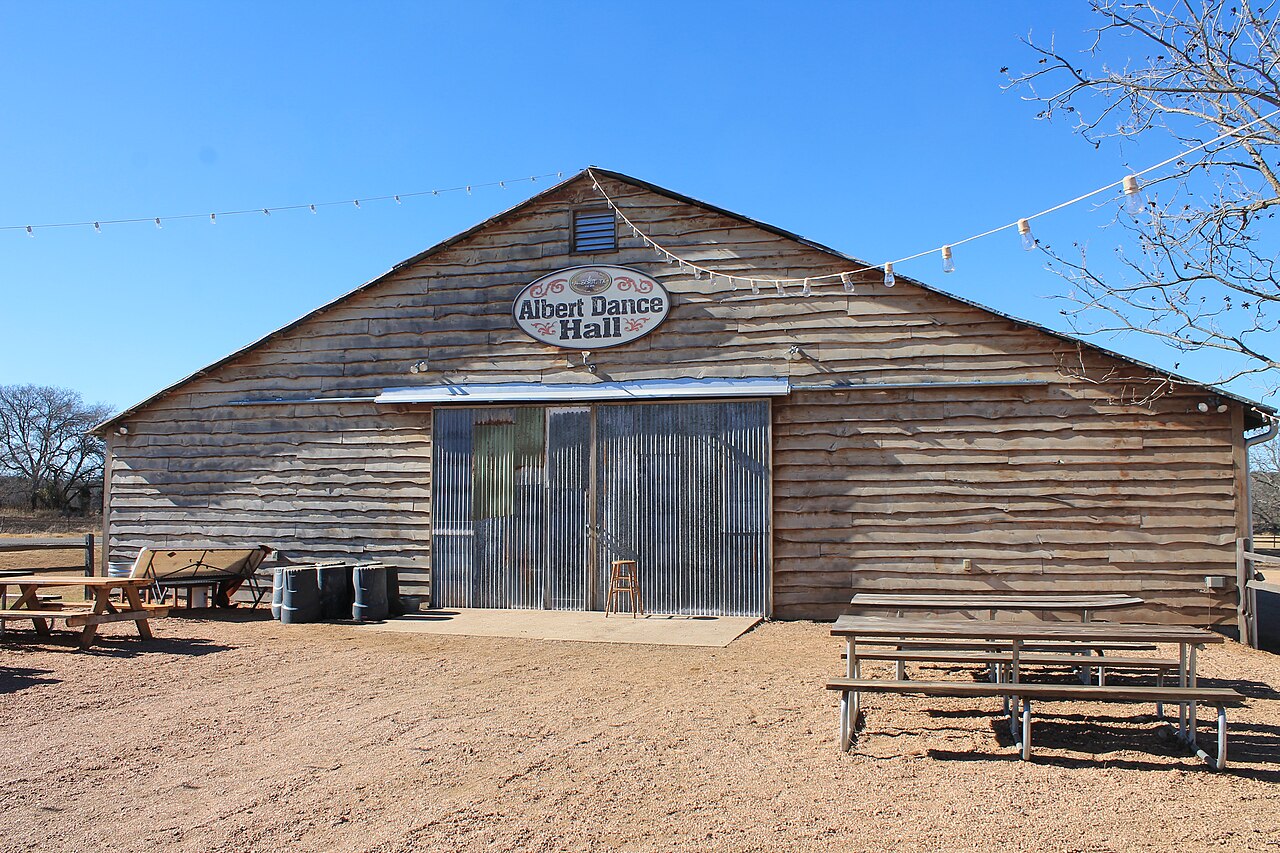
Take FM 1376 north toward Stonewall and Albert Dance Hall. Albert Luckenbach has two towns named after him, and this is the quieter one. Max Beckman built the dance hall in the 1920s, while Lyndon Johnson went to school right behind it. Since 2004, owners have brought the place back. Now free music plays under the oaks most days.
Then drive west to Luckenbach, the town that needs no introduction. Hondo Crouch bought it in 1970 and turned it into a state of mind. Soon, Jerry Jeff Walker recorded ¡Viva Terlingua! here in 1973. Four years later, Waylon and Willie put it on every jukebox in America. And now Pat Green has a new live album from Luckenbach in the works.
Stop 7: The End of the Road — Cherry Springs
Finish 16 miles northwest of Fredericksburg at Cherry Springs Dance Hall. Herman Lehmann, raised by Apaches and Comanches, opened it around 1889 for cattle drivers. On October 9, 1955, Elvis Presley and Johnny Cash played here on a Louisiana Hayride tour. However, the ad misspelled him as Clovis. Hank Williams and Patsy Cline reportedly played here, too.
Now, however, the hall sits empty behind a rusted tin roof. It’s private property, so view it from US 87. Still, stand there a minute. Imagine the cattle, the cowboys, and the kid from Tupelo. Then picture what happens to every hall on this list if nobody shows up.
Before You Go: Keep the Hill Country Dance Hall Trail Alive
Every stop on the Hill Country Dance Hall Trail survives on cover charges, cold beer, and volunteers. So buy a ticket, tip the band, and dance badly if you have to. Also, Texas Dance Hall Preservation publishes a public dance calendar and runs guided tours. Plan your drive around their schedule, not just your free weekend.
For a side trip south, add John T. Floore’s Country Store in Helotes. Willie Nelson played there for years, so it fits right in. And if you want the full regional picture, explore every Hill Country landmark on the map.
A dance hall is just a big wooden room until somebody fills it. On the Hill Country Dance Hall Trail, that part is up to you.
Featured photo: Albert Dance Hall by Renelibrary, Wikimedia Commons, CC BY-SA 3.0.