
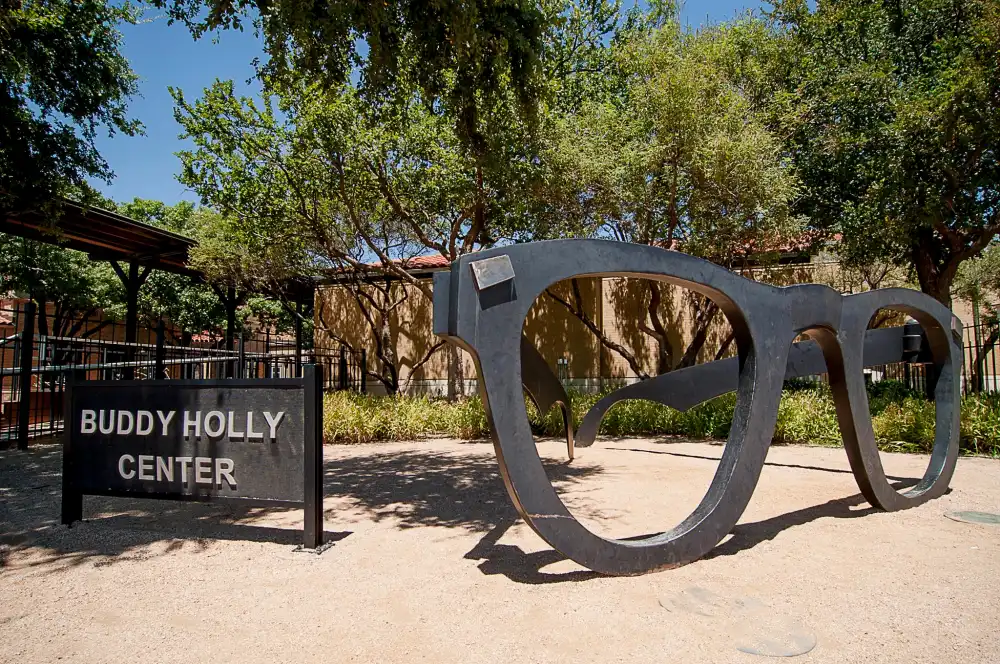
Buddy Holly, Waylon Jennings, and Joe Ely all grew up within 50 miles of each other. So did Bobby Keys, Mac Davis, Terry Allen, Angela Strehli, and Delbert McClinton. That’s not a coincidence. That’s West Texas. The Lubbock-High Plains Music Trail connects the birthplaces, the honky-tonks, the radio stations, and the hallowed ground where these artists found their voices. Some of these spots have plaques. Some just have the wind. All of them matter.
🎧 Listen to Buddy Holly on Apple Music
No other American city this size has produced this kind of musical firepower. Lubbock sits on the Llano Estacado — the vast, flat caprock of West Texas. Out here, cotton grows in long white rows and the wind never stops. That landscape forged something in the people who came up here. A stubbornness. A willingness to go their own way. You hear it in every record any of them ever made.
Trail stops: Buddy Holly Center → West Texas Walk of Fame → Buddy Holly Park → Buddy Holly Gravesite → KDAV Radio → Lubbock High School → Monterey High School → Stubb’s Bar-B-Q → The Cotton Club → Waylon Jennings Birthplace (Littlefield) → Bobby Keys Birthplace (Slaton)
→ View full trail route on Google Maps
Stop 1: Ground Zero — The Buddy Holly Center

Start at the Buddy Holly Center, at 1801 Crickets Ave. This is ground zero for the entire trail. Buddy Holly grew up in Lubbock and attended Lubbock High School. By age 22, he’d already changed the shape of rock ‘n’ roll. The Center holds his original horn-rim glasses, his guitars, and his handwritten letters. But what it really holds is the weight of what he started.
Holly’s influence on the Beatles, the Rolling Stones, and Bob Dylan runs deep. But he earned that influence right here in Lubbock. He played dances and radio shows before he was old enough to vote. Then he recorded “That’ll Be the Day” in 1957. And he lit a fuse that still hasn’t burned out.

Also at the Center: the West Texas Walk of Fame and the adjacent Buddy Holly Park. Waylon Jennings, Mac Davis, Joe Ely, Roy Orbison, Tanya Tucker, Bobby Keys, Terry Allen — all honored here, all from this same stretch of the High Plains. Then drive to the Buddy Holly gravesite at Lubbock City Cemetery. Holly died in February 1959 at age 22. Pilgrims still visit from around the world. Many leave guitar picks at the headstone.
Stop 2: The Radio That Built the Sound

Before any of them made records, they made radio. KDAV Radio — “Davey” to Lubbock — was one of the first all-country radio stations in America. Holly performed live on KDAV as a teenager. Then Waylon Jennings took a DJ job there in the late 1950s. He spun records in that studio and developed the deep, unhurried delivery that would define outlaw country. Without KDAV, you don’t get Waylon’s sound. Without Waylon’s sound, country music takes a very different road.
Stop 3: The Outlaw’s Birthplace — Littlefield

Drive 40 miles northwest to Littlefield. That’s where Waylon Jennings was born in 1937. The town’s water tower carries his name and face. KVOW Radio in Littlefield gave Waylon his first DJ job before Lubbock came calling. He later played bass in Buddy Holly’s touring band. He held a ticket on the fatal February 3, 1959 flight. He gave his seat to the Big Bopper. Holly and Ritchie Valens died in that crash. Waylon carried the weight of that night for the rest of his life. It changed him. And it changed his music.
Stop 4: The Honky-Tonks That Made Them

Back in Lubbock, Stubb’s Bar-B-Q on East Broadway was the unofficial clubhouse for West Texas musicians. C.B. Stubblefield opened his legendary pit in the 1960s. Joe Ely, Jimmie Dale Gilmore, and Butch Hancock played there constantly. When Stubbs moved to Austin, his spirit came with him. The Austin Stubb’s became one of the premier outdoor stages in America. But the Lubbock original is where that story began.
The Cotton Club predates Stubb’s by decades. Buddy Holly played there. Waylon played there. The room had a low ceiling and a sprung dance floor. On a Saturday night, it held more raw West Texas energy than most cities see in a year.
Stop 5: The Schools That Shaped the Lubbock Sound

Lubbock High School sent two giants into American music. Buddy Holly walked those halls in the early 1950s. So did Mac Davis — who later wrote “In the Ghetto” and “A Little Less Conversation” for Elvis Presley. Today, Mac Davis Lane runs through downtown Lubbock. His gravesite draws visitors who remember both the songwriter and the showman.

Monterey High School produced a different kind of genius. Joe Ely, Jimmie Dale Gilmore, and Butch Hancock all graduated from Monterey. So did Terry Allen. These four became the core of the Lubbock Lights — a West Texas musical movement unlike anything before or since. Their Flatlanders album sat unreleased for years after recording in 1972. When critics finally heard it, they called it a masterpiece. It still holds up.
Stop 6: Terry Allen, Bobby Keys, and Angela Strehli

The West Texas Walk of Fame includes Terry Allen — a man who refused every category the music business offered. His album Juarez remains one of the strangest and most powerful records Texas has ever produced. Allen also sculpts. His work stands at DFW Airport and the Wittliff Collections in San Marcos. He belongs to Lubbock the way Lubbock belongs to the wind: completely, and on his own terms.
Bobby Keys grew up 30 miles south of Lubbock in Slaton. He was born December 18, 1943 — the same birthday as Keith Richards. That shared birthday sparked a friendship that lasted decades. Keys played saxophone on “Brown Sugar,” “Tumbling Dice,” and dozens of other Rolling Stones recordings. He was the quintessential West Texas sideman: tough, loyal, and absolutely on fire.

Angela Strehli grew up in Lubbock and brought the blues back to Texas with force. Her story connects West Texas to the Austin blues explosion of the 1970s. She helped build Antone’s, the legendary Austin club. And she mentored a generation of Texas blues players. Also worth knowing: Delbert McClinton’s West Texas roots run through Lubbock too. McClinton played harmonica on Bruce Channel’s 1962 hit “Hey! Baby.” Then he showed John Lennon how to play it. No Lubbock, no Beatles harmonica. Think about that.
Before You Leave: Dig the Crates

No music trail ends without a record store. Ralph’s Records has served Lubbock for decades — a serious vinyl shop with real knowledge behind the counter. Hub City Records carries local and regional releases alongside the classics. And The Spins Vinyl Café offers something rare: good coffee, real conversation, and records in the same room. Take something home from Lubbock. The musicians who grew up here took the sound of this place around the world. You can carry a small piece of it with you.
The wind doesn’t stop in Lubbock. But now you know why that matters.