
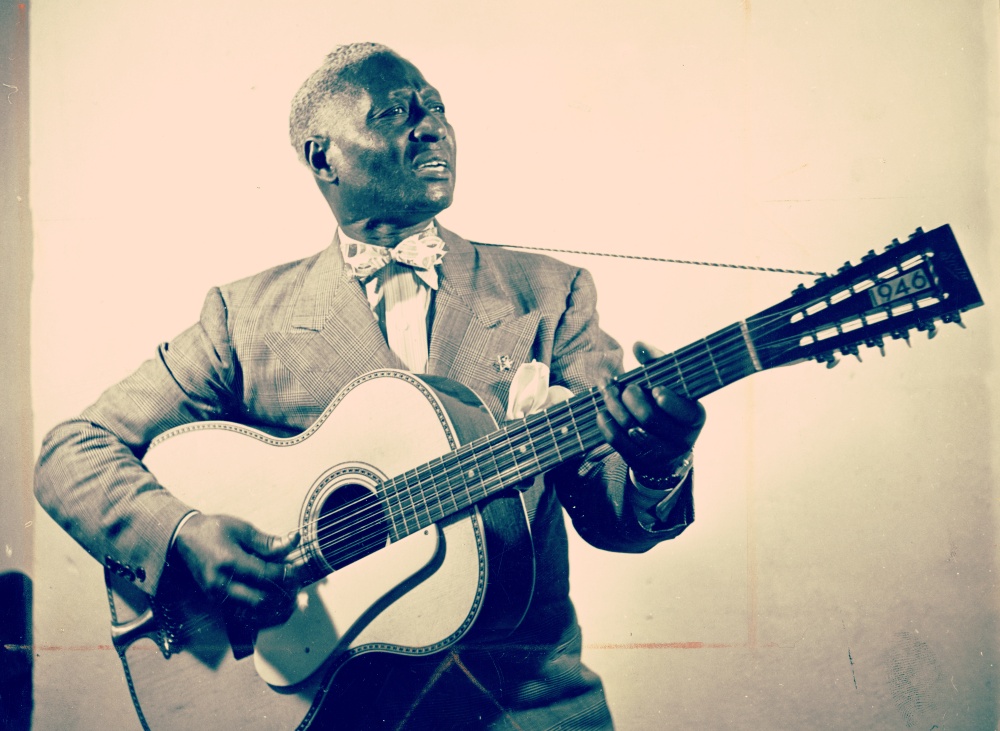
Every time the governor came to dinner, they brought Huddie Ledbetter out to play.
Ledbetter would walk across the prison yard to the back porch of Warden R.J. Flanagan’s white-columned house. He tuned his 12-string guitar. Then he played the governor a song he’d written himself — a song begging to go home.
“If I had you, Governor Neff, like you got me,” he sang, “I’d wake up in the morning, and I’d set you free.”
Governor Pat Neff had made a campaign promise not to pardon anyone. But Ledbetter played anyway — every time, until the governor finally heard him.
From Mooringsport to the Brazos

Huddie William Ledbetter entered the world on January 21, 1888, near Mooringsport, Louisiana. The Caddo Lake country there straddles the Texas-Louisiana border — cypress swamp and red clay, all the way to the horizon. His father Wes farmed the land. His mother Sally was part Indian. The family wasn’t poor. By the time Huddie was 10, they had moved to Harrison County, Texas, and bought their own farm.
By 14, people knew his name across the Caddo Lake circuit. He played accordion, then guitar, then anything he could get his hands on at house parties and sukey jumps. He left home at 13 to make his way on Fannin Street in Shreveport — the blues street, where things happened.
In Dallas, he met Blind Lemon Jefferson. Jefferson played the 12-string guitar — twice the strings, twice the sound, built to fill a field without a microphone. Ledbetter learned it immediately. He never played anything else again.
The Hellhole on the Brazos
In 1918, under the alias Walter Boyd, a Harrison County court convicted Ledbetter of murder. The judge sentenced him to 30 years in the Texas penitentiary. He arrived at the Imperial State Prison Farm in Sugar Land. Convicts called it “the Hellhole on the Brazos.”
The Imperial Farm occupied the bottomlands of the Brazos River, southwest of Houston in Fort Bend County. The fields ran to the horizon. Prisoners worked sugarcane and cotton under a Gulf Coast sun. The buildings were unsanitary. The water was unsafe. Flies and mosquitoes swarmed every season. Texas had only just ended its convict-leasing program — in which the state forced inmates to labor for private parties, often worked to death — less than a decade before Ledbetter arrived.
Ledbetter first tried to escape. It didn’t work. He changed strategy — he became a model prisoner. He got hold of a guitar and played for his fellow inmates. Then for the warden. Then for whoever Flanagan invited to dinner.
Somewhere in those years he picked up the nickname Lead Belly. Some say a gunshot wound to the stomach gave it to him. Others credit his killing pace on the chain gang. Either way, it stuck — and it rhymed with Ledbetter.
The Song for the Governor
Governor Pat Neff was a sober Baptist from Waco. He took office in 1921 on a reform platform — no corruption, no pardons. His predecessor had sold pardons like cattle, and Neff wanted no part of that history. He made the pledge publicly, and he meant it.
But Neff liked visiting Sugar Land. He made Warden Flanagan’s house a regular stop. And each time he arrived, Flanagan summoned Ledbetter to the back porch.
Ledbetter had written a song for exactly these moments. He called it “Governor Pat Neff,” though it sometimes went by “Sweet Mary.” The key verse ran: If I had you, Governor Neff, like you got me / I’d wake up in the morning, and I’d set you free / Goin’ back to Mary, sweet Mary.
Mary, it bears noting, had already left him. That detail never made the song.
Neff heard the song on every visit. He later recalled it in his autobiography. That voice, that 12-string, that plea rising from the warden’s porch — it stuck.
The Last Day
On January 25, 1925, Governor Pat Neff’s last day in office, he granted Huddie Ledbetter a full pardon. Ledbetter walked out of the Imperial Farm having served six years, seven months, and eight days of a thirty-year sentence. The songs had done what the law said couldn’t be done.
What Freedom Built
Five free years followed. Ledbetter worked odd jobs between gigs, playing blues and folk across Texas and Louisiana. Then, in 1930, another fight landed him in Angola Prison — the most notorious penitentiary in Louisiana. He thought he was finished.
In 1933, Texas folklorists John Avery Lomax and his son Alan arrived at Angola. They came to record work songs and field hollers for the Library of Congress. When they heard Ledbetter play, they stopped everything.
They recorded him performing “Midnight Special” — a song he had picked up at the Imperial Farm. At Sugar Land, prisoners believed that if the midnight train’s headlight shone on you through the bars, you’d go free. Lead Belly had carried that song out of Sugar Land. Now the Lomaxes carried it to the world.
Lead Belly earned his release from Angola on good behavior. On January 4, 1935, John Lomax brought him to New York City. He performed at a luncheon for Texas alumni at the Hotel Montclair in Midtown. Lead Belly walked in wearing high-bib overalls, a red bandanna, and a small-brimmed hat pushed back on his head. He carried a battered green Stella 12-string guitar, partly held together with string.
Reporters from the Herald Tribune, TIME, and the Associated Press jostled for position. When Lead Belly played, the room fell silent. The Herald Tribune ran the headline: SWEET SINGER OF THE SWAMPLANDS HERE TO DO A FEW TUNES BETWEEN HOMICIDES. The legend had found its audience.
Lead Belly spent the rest of his life in New York, playing alongside Woody Guthrie, Pete Seeger, and Sonny Terry. He’d played “Goodnight, Irene” since his Texas days — a slow, aching thing that sounded like it had always existed. The Weavers took it to number one in 1950. He never saw it chart. Lead Belly died of Lou Gehrig’s disease on December 6, 1949. He rests at Shiloh Baptist Church north of Shreveport, Louisiana.
The Bottomlands Today
The site of the old Imperial State Prison Farm lies outside Sugar Land in Fort Bend County, southwest of Houston. The Texas Department of Criminal Justice operates the Central Unit there today. It sits on the same bottomlands where Lead Belly once worked the fields and played for a governor on a back porch.
In 2018, construction workers near the old prison site found the remains of nearly 100 people. Most had likely died as slaves or prisoners under the convict-leasing program — the brutal system that preceded Lead Belly’s time. Fort Bend County now works to preserve and memorialize the site.
The railroad tracks still run past the property. The same line once carried the Midnight Special. Prisoners believed that if the train’s light touched you, freedom would follow. For Huddie Ledbetter, that’s almost exactly what happened — though the light that reached him came off a 12-string guitar, not a locomotive.
***
For more Texas music history hiding in plain sight, read our story on The Night Tina Turner Crossed the Freeway — another piece of American music forged in a moment of crisis in a Texas city. And for a stranger tale still, see The Legend of Andrew McCrew, the one-legged hobo from Marlin whose death in 1913 inspired a Don McLean song.