
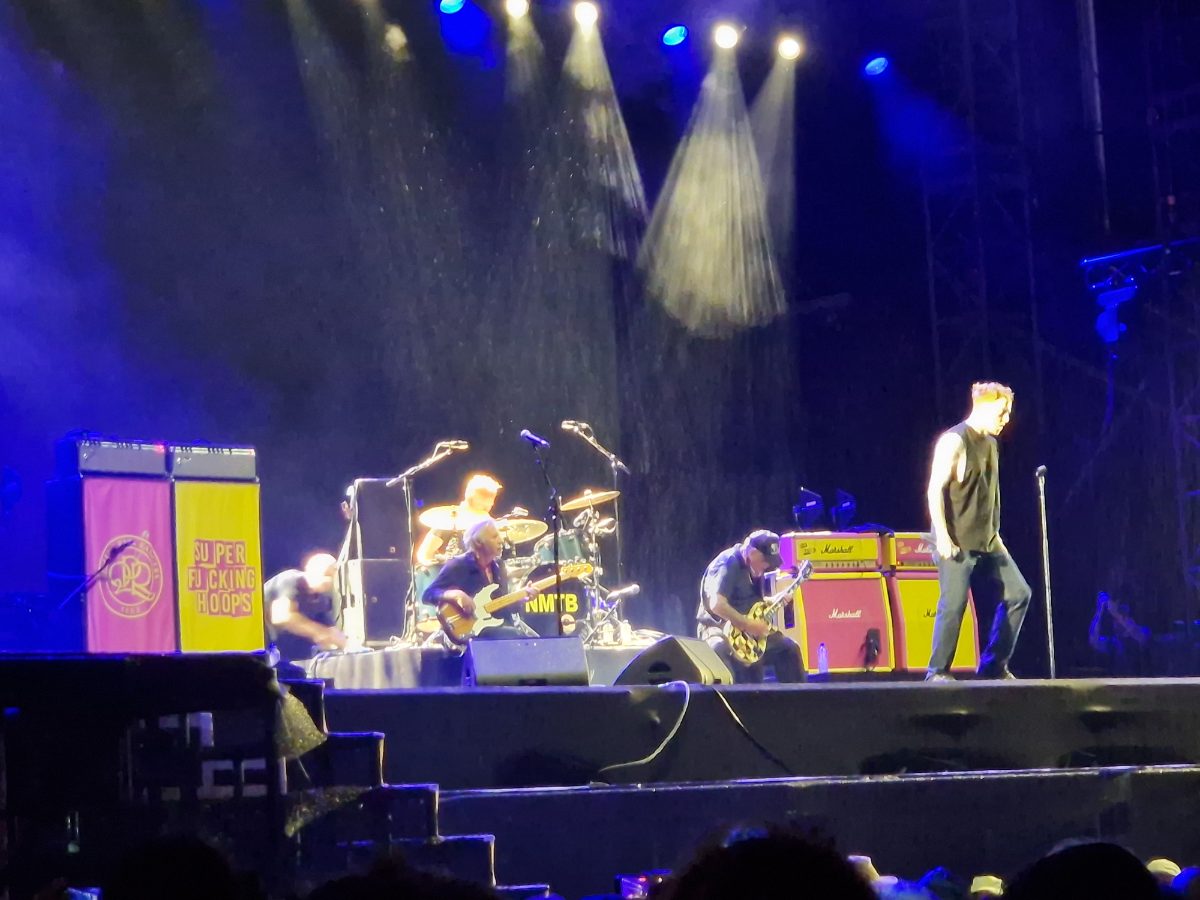
The opening chords unleashed a blizzard of beer cans. Then Sid Vicious picked up his bass.
The Sex Pistols’ only American tour was seven dates long — and manager Malcolm McLaren designed every city like a trap. Atlanta. Memphis. San Antonio. Baton Rouge. Dallas. Tulsa. Then a final blowout at the Winterland Ballroom in San Francisco. No New York. No Los Angeles. No college towns with knowing crowds and record-store credibility. McLaren booked country-and-western halls deep in the American South, where British punk had no context, no precedent, and almost no fans. He wanted collisions, not concerts.
By the time the band touched down in Texas, the tour had already produced front-page news, a brawl or two, and one legendary piece by Rolling Stone writer Charles M. Young, who followed the Pistols across the South like a prophet chasing a burning bush. San Antonio was the third stop: January 8, 1978.
The Honky-Tonk on Bandera Road
Randy’s Rodeo sat in a former bowling alley at 1534 Bandera Road on San Antonio’s west side — a big, cavernous dance hall where KISS-FM disc jockeys Joe Anthony and Lou Roney had been booking acts since the early 1970s. They’d brought Rush here once and had to build an extension onto the stage just to fit all the equipment. On most nights, Randy’s was a cowboy bar: Lone Star on tap, Waylon on the jukebox, and boots on every foot. It held about 2,200 people.
On January 8, 1978, those 2,200 people showed up to see the Sex Pistols. Most of them, by more than one account, had come hoping to destroy the band.
Cowboys vs. Punks

Johnny Rotten walked onstage in what Rolling Stone‘s Charles M. Young described as “a massively ill-fitting plaid bondage suit” and a T-shirt depicting two cowboys facing each other with their huge dicks hanging out. Sid Vicious was shirtless, lean and white as a hospital wall, with “Gimme a Fix” scrawled in marker across his chest. Guitarist Steve Jones wore the look of a man who had agreed to something he now deeply regretted. Drummer Paul Cook simply hit things.
Vicious stepped to the mic first. “Ya cowboy faggots!” he announced to 2,200 Texans.
The response was immediate. The opening chords of the first song unleashed a blizzard of beer cans, bottles, spit, and — improbably — handfuls of whipped cream. The band played through it. Rotten stalked the stage, hunched and sneering, hurling insults back at the crowd between songs. “All you cowboys are faggots,” he offered at one point. The crowd roared. Some of them were laughing. Some were genuinely furious. Most, as Young noted dryly, stood around watching “as if it had no more reality than the goddamn Today show.”
A local San Antonio band called the Vamps had opened the show. Their singer, Frank Pugliese, had done his best. Nobody remembered much about the Vamps after that night.
Sid Swings His Bass
Midway through the set, an audience member named Brian Faltin had stationed himself directly in front of Sid Vicious and had been flipping him off with dedicated persistence for several songs. When a particularly hard-thrown can connected with Vicious, something snapped. He lifted his bass guitar above his head and brought it down hard on Faltin’s skull.
Journalist accounts of what followed diverged sharply. “Sid went ballistic, mowing his bass recklessly through the audience like a scythe,” one reporter wrote. Another described the moment with more compression: “It was at this point that rock ‘n’ murder barely got missed, and I’ll never forget how close it all came.”
Rotten watched the scene unfold from a few feet away. “Oh my,” he said mildly into the microphone. “Sid dropped his guitar.”
The band finished the set. By the end, the stage was buried under debris. The blizzard of cans had made it through every song.
The Drive Home to Austin
Scattered through the crowd at Randy’s that night were dozens of people who had driven down from Austin — young musicians and record-store kids and art-school types who had heard something was happening in the world and wanted to see it firsthand. Virtually everyone who would come to form Austin’s first punk scene was reportedly in that building on Bandera Road on January 8th.
On the drive back up I-35 through the dark Hill Country, conversations kept circling to the same point. Future members of the Huns described it later: “That was awesome. Y’know — we can do that.” And then, within weeks, they did.
Two weeks after Randy’s Rodeo, the Skunks and the Violators played the first punk night at Raul’s on Guadalupe Street in Austin, and Texas punk had its first regular stage. The bands that grew out of that night — the Huns, the Standing Waves, the Delinquents, the Next — traced their origins, directly or indirectly, to the chaos at Randy’s Rodeo. The Austin Chronicle called the show “Texas punk’s big-bang moment.” That wasn’t an exaggeration.
Randy’s Today

The building at 1534 Bandera Road is still standing. St. George Maronite Catholic Church bought the old ballroom in the early 2000s and converted it into their fundraising bingo hall — Randy’s Bingo. On most nights now, the same cavernous space where Sid Vicious brained an audience member with a bass guitar hosts church bingo. Folding tables where the pit used to be. Daubers where the beer cans flew.
The Sex Pistols played their final show six days later, on January 14, 1978, at the Winterland Ballroom in San Francisco. At the end of the set, Johnny Rotten turned to face the crowd and said: “Ever get the feeling you’ve been cheated?” Then he walked off the stage, and the band was over.
Nobody who was at Randy’s Rodeo that night ever forgot it. Neither did Texas punk.